Phytoestrogens in Skincare: Efficacy, Use Cases, and How They Compare to Topical Estrogen
A deeper look at plant-based, estrogen-like ingredients and what the research really tells us.
As estrogen-dependent skin changes become a bigger topic in beauty and dermatology, so has the interest in phytoestrogens as being the "natural" answer — showing up in everything from soy-based creams to red clover serums. These plant-derived compounds bind to estrogen receptors with weak affinity, which is why they're increasingly spotlighted in formulas aimed at supporting perimenopausal and menopausal skin.
Still, the science is mixed, and the claims can get ahead of the evidence. This article unpacks what phytoestrogens are, how they work in skin, what has been clinically validated so far, and how their effects stack up against prescription topical estrogen and estriol-based cosmeceuticals.
What Are Phytoestrogens?
Phytoestrogens are plant-derived compounds with a structure similar enough to mammilian estrogen that they can interact—weakly—with estrogen receptors in the skin. Although far less potent than human estrogen, they remain biologically active, especially as estrogen levels decline during perimenopause and menopause.
Common categories include:
Isoflavones: genistein, daidzein, and their gut bacterial metabolite equol (from soy)
Lignans: flaxseed extract
Coumestans: red clover, coumestrol
Polyphenols with mild estrogenic effects: resveratrol
Other botanicals: kudzu root, biochanin A
Why Estrogen Matters for Skin
Estrogen helps maintain:
Collagen and elastin quality
Dermal and epidermal thickness
Ceramide formation and hydration
Sebum production
Transepidermal water loss regulation
Wound healing
Antioxidant and anti-inflammatory pathways
When estrogen declines, the skin becomes thinner, drier, less elastic, and more prone to wrinkles—driving interest in both topical estrogen (in appropriate clinical contexts) and phytoestrogens.
How Phytoestrogens Work in the Skin
Even at much lower potency, phytoestrogens can support estrogen-deficient skin through several pathways:
1. Mild Estrogen-Receptor Activation
Many phytoestrogens preferentially bind to ERβ, the receptor associated with anti-inflammatory and antioxidant benefits, while having minimal ERα activity, which may reduce concerns about systemic hormonal effects. Their binding affinity is low, but still enough to influence signaling in aging skin.
2. Collagen + Dermal Support
Isoflavones like genistein and daidzein have shown:
Increased collagen synthesis
Reduced collagen breakdown (via MMP inhibition)
Improved dermal density in some studies
These effects are measurable, but significantly weaker than prescription estrogen.
3. Barrier + Hydration Improvements
Some phytoestrogens, particularly soy isoflavones, enhance ceramide production and reduce transepidermal water loss, improving the dryness and barrier fragility common in menopausal skin.
4. Antioxidant & Anti-Inflammatory Protection
Resveratrol, red clover, soy isoflavones, biochanin A, and others help neutralize reactive oxygen species (ROS) and reduce UV-induced oxidative stress—useful for photoaging. Notably, some of these antioxidant effects occur through direct radical scavenging, independent of estrogen receptor binding.
Genistein, daidzein, and equol are among the most studied, with data showing protection of keratinocytes from UVB-induced oxidative damage and improvement in extracellular matrix integrity.
What the Evidence Actually Shows
Soy Isoflavones (Genistein, Daidzein)
Among all phytoestrogens, soy is the most extensively studied. Topical genistein and related isoflavones have demonstrated increased dermal thickness, reduced wrinkle depth, improved elasticity, enhanced collagen synthesis, and lower oxidative stress. Clinical improvements are modest but consistently reproducible, making soy one of the most evidence-supported options in this category.
Red Clover Extract
Red clover contains isoflavones including biochanin A (which converts to genistein) and formononetin. Studies show mild improvements in texture, hydration, and elasticity, though results are less robust and less consistent than soy-derived isoflavones.
Resveratrol
While not a classical phytoestrogen, resveratrol binds estrogen receptors with low affinity and contributes significant antioxidant protection, anti-inflammatory benefits, mild brightening, and support for barrier repair. Its estrogenic activity is weak, but its antioxidant profile makes it valuable for photoaging support.
Kudzu (Pueraria lobata)
Kudzu contains puerarin, a compound with estrogen-like activity. Early data suggests potential improvements in collagen density, reduced glycation, and fine-line appearance. Research is promising but still limited compared to soy or equol.
Phytoestrogens vs. Topical Estrogen: How Do They Compare?
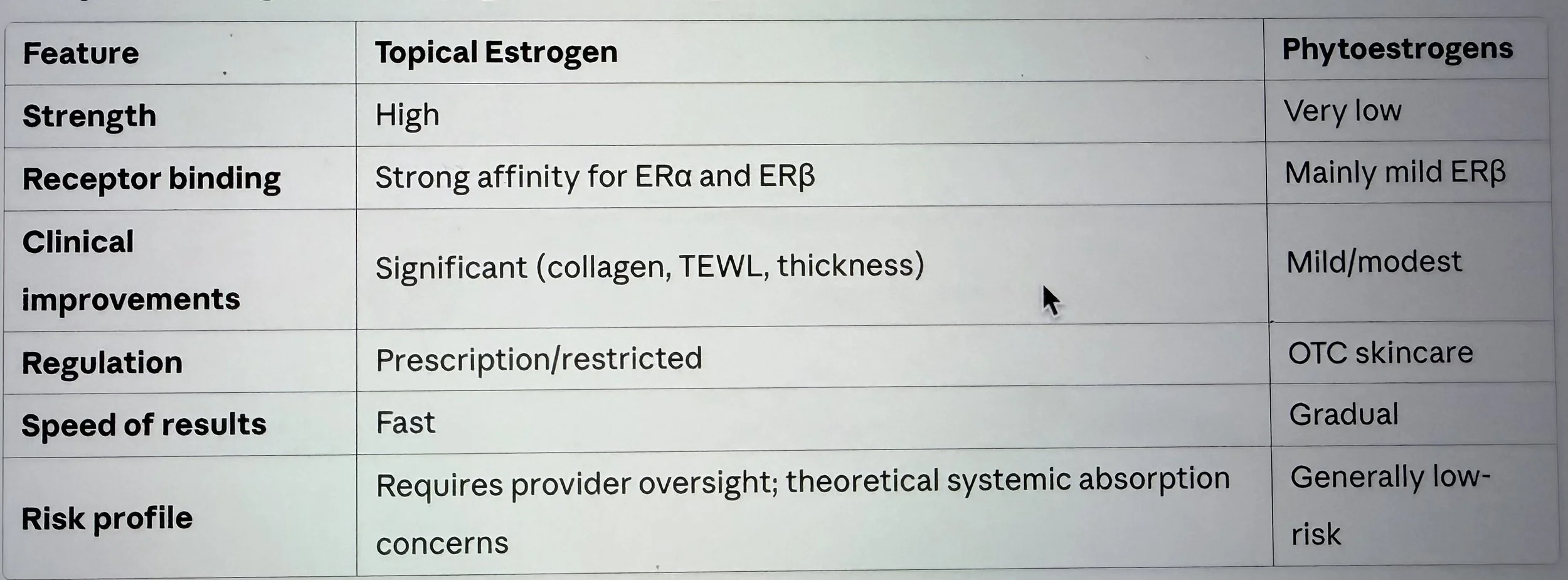
Bottom line: Phytoestrogens provide gentle, accessible support for estrogen-deficient skin, but they are not a substitute for topical estrogen in individuals with significant estrogen-related skin changes. For women who are not candidates for topical hormonal therapy—or who prefer non-hormonal options—phytoestrogens offer a safe, evidence-informed alternative with measurable (but modest) benefits.
Direct Comparative Evidence
Genistein vs. Estradiol
A 24-week randomized, double-blind study compared topical genistein 40% to topical estradiol 0.01% in postmenopausal women (Silva et al., 2017). Estradiol significantly outperformed genistein across multiple parameters:
Epidermal thickness: estradiol ↑ 75% vs. genistein ↑ 20% from baseline
Dermal papillae: estradiol ↑ 125% vs. no significant change with genistein
Fibroblast count: estradiol ↑ 123% vs. no significant change with genistein
Both increased type I and III collagen, though estradiol remained clearly superior.
Another study evaluating a genistein + vitamin E + niacinamide + ceramide formulation showed improvements in hydration, pore size, and wrinkles after 6 weeks, particularly in women over 56, suggesting that synergistic formulations may enhance results (Moraes et al., 2009).
Equol-Specific Evidence
Equol is one of the more compelling phytoestrogens in dermatology research. In a study of 64 participants over 8 weeks, both pure equol and microencapsulated equol improved roughness, texture, smoothness, firmness, and elasticity compared to placebo. Notably, equol treatment was associated with longer epidermal telomeres in this study, suggesting potential benefits for cellular aging markers.
Safety Profile
Topical phytoestrogens consistently demonstrate excellent tolerability across clinical trials, with minimal irritation, no significant barrier disruption, and no evidence of endometrial or vaginal estrogenic stimulation—even with use up to 2 years. Systemic absorption of phytoestrogens from topical application is minimal to undetectable, which further supports their favorable safety profile. This represents a major advantage over topical estradiol, which carries theoretical risks of systemic absorption.
Limitations
Current evidence is still limited for men, premenopausal women, and individuals with darker skin types (Fitzpatrick IV–VI), highlighting a need for more diverse clinical research in these groups. Additionally, long-term data beyond 2 years remains sparse for most phytoestrogens except soy.
Overall Takeaway
Topical estradiol is far more potent for addressing true estrogen-deficient skin changes. However, phytoestrogens—particularly genistein formulations and equol—offer clinically meaningful improvements, low irritation potential, a strong safety margin, and non-hormonal accessibility. For women seeking anti-aging support rooted in biology without hormonal therapy, phytoestrogens represent a scientifically supported, well-tolerated middle ground.
Who Might Benefit From Phytoestrogens?
Phytoestrogens are best suited for postmenopausal women experiencing estrogen-deficient skin changes—including thinning, dryness, reduced elasticity, increased wrinkling, and delayed wound healing. They offer particular value for women who:
Are not candidates for topical estrogen due to personal or family history of hormone-sensitive cancers (breast, uterine), cardiovascular disease, or thromboembolic disorders—or whose providers exercise caution in prescribing topical hormones in these contexts
Prefer non-hormonal alternatives for personal or philosophical reasons
Seek low-irritation, accessible anti-aging support with a strong safety profile
Clinical outcomes are most robust in women ≥56 years postmenopausal (Moraes et al., 2009), with studies reporting wrinkle reduction, improved hydration (up to ~68% on the cheeks), enhanced firmness and elasticity, and reduced pore appearance after 6–24 weeks of consistent use.
Equol-Based Formulations: A Targeted Option
Equol may offer enhanced benefits for structural skin aging, including potential cellular aging markers like epidermal telomere length. However, individual responses vary: only 30–50% of people naturally produce equol from dietary soy due to gut microbiota differences. Topical equol formulations bypass this variability by delivering the active metabolite directly, making them a more reliable choice than oral soy supplementation for skin benefits.
Final Takeaway
Phytoestrogens offer evidence-supported benefits for aging and estrogen-deficient skin, with documented improvements in hydration, collagen support, elasticity, and overall skin quality. While not as potent as prescription topical estrogen, they provide meaningful dermal support with excellent tolerability and a favorable safety profile.
For women seeking a non-hormonal, low-irritation approach to skin rejuvenation—or those who are not candidates for estrogen-based treatments—phytoestrogens represent a valuable, biologically grounded addition to a comprehensive anti-aging plan.
References
Shu YY, Maibach HI. Estrogen and skin: therapeutic options. Am J Clin Dermatol. 2011;12(5):297-311. doi:10.2165/11589180-000000000-00000
Liu T, Li N, Yan YQ, et al. Recent advances in the anti-aging effects of phytoestrogens on collagen, water content, and oxidative stress. Phytother Res. 2020;34(3):435-447. doi:10.1002/ptr.6538
Irrera N, Pizzino G, D'Anna R, et al. Dietary management of skin health: the role of genistein. Nutrients. 2017;9(6):E622. doi:10.3390/nu9060622
Intharuksa A, Arunotayanun W, Na Takuathung M, et al. Daidzein and genistein: natural phytoestrogens with potential applications in hormone replacement therapy. Int J Mol Sci. 2025;26(14):6973. doi:10.3390/ijms26146973
Silva LA, Ferraz Carbonel AA, de Moraes ARB, et al. Collagen concentration on the facial skin of postmenopausal women after topical treatment with estradiol and genistein: a randomized double-blind controlled trial. Gynecol Endocrinol. 2017;33(11):845-848. doi:10.1080/09513590.2017.1320708
Moraes AB, Haidar MA, Soares Júnior JM, et al. The effects of topical isoflavones on postmenopausal skin: double-blind and randomized clinical trial of efficacy. Eur J Obstet Gynecol Reprod Biol. 2009;146(2):188-192. doi:10.1016/j.ejogrb.2009.04.007
Na Takuathung M, Klinjan P, Sakuludomkan W, et al. Efficacy and safety of the genistein nutraceutical product containing vitamin E, vitamin B3, and ceramide on skin health in postmenopausal women: a randomized, double-blind, placebo-controlled clinical trial. J Clin Med. 2023;12(4):1326. doi:10.3390/jcm12041326
Rizzo J, Min M, Adnan S, et al. Soy protein containing isoflavones improves facial signs of photoaging and skin hydration in postmenopausal women: results of a prospective randomized double-blind controlled trial. Nutrients. 2023;15(19):4113. doi:10.3390/nu15194113
Magnet U, Urbanek C, Gaisberger D, et al. Topical equol preparation improves structural and molecular skin parameters. Int J Cosmet Sci. 2017;39(4):407-412. doi:10.1111/ics.12408
Lephart ED. Resveratrol, 4' acetoxy resveratrol, R-equol, racemic equol or S-equol as cosmeceuticals to improve dermal health. Int J Mol Sci. 2017;18(6):E1193. doi:10.3390/ijms18061193
Wu AH, Yu MC, Tseng CC, Pike MC. Epidemiology of soy exposures and breast cancer risk. Br J Cancer. 2008;98(1):9-14. doi:10.1038/sj.bjc.6604145
Rowland IR, Wiseman H, Sanders TA, Adlercreutz H, Bowey EA. Interindividual variation in metabolism of soy isoflavones and lignans: influence of habitual diet on equol production by the gut microflora. Nutr Cancer. 2000;36(1):27-32. doi:10.1207/S15327914NC3601_5
Lethaby A, Marjoribanks J, Kronenberg F, Roberts H, Eden J, Brown J. Phytoestrogens for menopausal vasomotor symptoms. Cochrane Database Syst Rev. 2013;(12):CD001395. doi:10.1002/14651858.CD001395.pub4
Disclaimer: The information shared on this website and all blog articles by Esther's Wellness is for educational and informational purposes only. It is not intended to diagnose, treat, cure, or prevent any disease and should not replace advice from a qualified healthcare professional. Always seek the guidance of your physician, dermatologist, or other licensed healthcare provider with any questions you may have regarding your skin, medical conditions, or before starting any new skincare regimen, supplement, or treatment. Although the founder of Esther's Wellness is a licensed pharmacist, all content provided here is shared in a general educational capacity and does not create a pharmacist-patient or provider-patient relationship. Esther's Wellness makes no guarantees regarding the accuracy, completeness, or suitability of the information provided and assumes no liability for any actions taken based on this content.